
Travis County Court Records After Arrest
The Travis County arrest-to-court path starts with transport to Central Booking. TCSO creates the jail booking record, then bond and magistration occur under Texas procedure. Prosecutor review follows. The Travis County District Attorney's Office says District Attorney José P. Garza leads the office and that the office prosecutes all felony cases that occur in Travis County. Misdemeanor cases may involve the county attorney and county-court path. The court record appears after a complaint, information, indictment, or other filing opens the case in the right court.
Jail booking charges are not the final word. Prosecutors can reject, amend, reduce, enhance, dismiss, or refile allegations. That is why court records after a jail arrest should be read separately from Travis County jail inmate records. The custody side answers whether a person is booked, housed, bonded, or released. The court side answers what charge was filed, what hearings are set, and what the current case status is. Booking photos are a separate records issue handled on the Travis County jail mugshots page.
The Travis County Odyssey Portal is the main online public case-search access point for court records after a jail arrest.
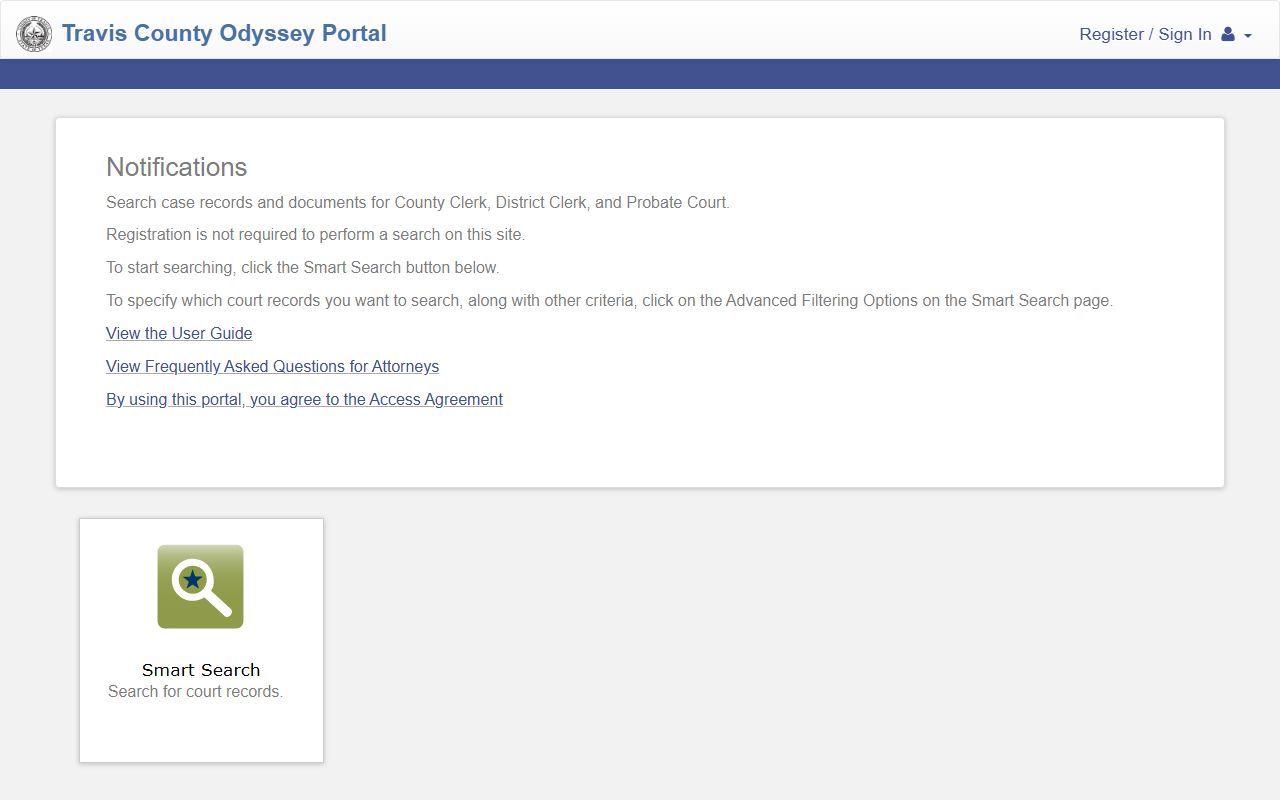
Odyssey is where a custody event can be matched to a filed court case when a case number or party name is available.
Find Travis County Court Records After Arrest
Use the Travis County Odyssey Portal first when looking for court records after an arrest. The District Clerk is the custodian of district-court pleadings, instruments, and papers, and its page advertises case information and records search. The County Clerk is the starting point for county-court and misdemeanor records. If the online portal does not show a case, the record may not be indexed yet, the charge may have been declined, the case may be in a different court, or the name may be entered differently than it appears in the jail record.
- Open the Travis County Odyssey Portal and choose the public case-search path.
- Search by defendant name, case number, or party information if known from jail paperwork.
- Use case type, court, or criminal filters when the portal offers them.
- Open the matching case and review the charge list, docket, bond entries, hearings, and disposition fields.
- Contact the District Clerk, County Clerk, or defense counsel when the online record is missing or unclear.
For felony charge context, the Travis County District Attorney is the official source for prosecution role and victim-service resources. For custody status, use TCSO and the jail information line. Court records and jail records answer related but different questions.
Travis County Case Search Fields
The Odyssey portal fields can vary by portal state, but the research captured a high-level field set. A case number is the cleanest path when it is printed on release paperwork or a clerk notice. A name search is common, but it can return many results, especially when a person has a common surname or multiple cases.
| Field Label | Type | Required | Notes |
|---|---|---|---|
| Smart Search / case search | Text | Usually one search term required | Search by name, case number, or party information. |
| Case number | Text | Optional if name used | Use when known from jail paperwork or a clerk notice. |
| Party name | Text | Optional if case number used | Defendant name search. |
| Case type / court filters | Dropdown or filter | Optional | Criminal, civil, family, or court-specific filters may be available after portal load. |
Charges Filed After Travis County Arrest
After arrest and booking, the court case begins through a charging document or docket event. A complaint is a sworn allegation that can start a criminal process. An information is a prosecutor's charging document, often used for misdemeanors and some waived felony processes. An indictment is a grand-jury charging document for a felony. These records are the bridge between jail custody and formal court records after a jail arrest.
| Document | Who Creates It | Common Use | Why It Matters |
|---|---|---|---|
| Complaint | Officer or prosecutor through a sworn allegation | Initial criminal process and some misdemeanor filings | Shows the alleged conduct that starts the case. |
| Information | Prosecutor | Misdemeanors and some felony processes when allowed | Shows the prosecutor's filed charge. |
| Indictment | Grand jury | Felony prosecution | Shows a grand jury's formal felony accusation. |
Travis County Charge Status
Charge status tells where a case stands. The same arrest can produce a booking label, a filed charge, an amended charge, a dismissal, or a conviction at different points. A pending charge is still open. A dismissed charge ended without conviction. An amended or reduced charge means the prosecutor changed the allegation. A conviction means guilt was adjudicated by plea, verdict, or other court action. A disposition is the current or final outcome shown in the court record.
| Status | What It Means | Where to Verify |
|---|---|---|
| Pending | The case is open and has not reached final disposition. | Odyssey, clerk docket, counsel. |
| Amended / reduced | The prosecutor changed the filed charge. | Court docket and filed charging documents. |
| Dismissed | The charge or case ended without a conviction. | Disposition entry or clerk-certified record. |
| Indicted | A grand jury returned a felony charging document. | District court record and District Clerk. |
| Convicted | Guilt was adjudicated through plea, verdict, or judgment. | Judgment, sentence, and clerk record. |
Bond Records After Travis County Arrest
TCSO's bond page applies to defendants in TCSO custody and tells users to call 512-854-4180 to find where the defendant is housed before paying a cash bond. Cash bond is paid at the jail facility where the defendant is housed, either the Bonding Office or the Travis County Correctional Complex. If the defendant appears and the case is disposed, a refund order is issued by the court. TCSO notes misdemeanor Class A, Class B, and appealed Class C cash refunds are processed through the Travis County Clerk, while felony cash refunds are processed through the District Clerk.
| Bond Type | How It Works |
|---|---|
| Cash bond | Full bond amount paid in person at the correct jail or bonding location. |
| Personal bond | A sworn promise to appear, requested by Pretrial Services or an attorney and approved by a judge. |
| Surety bond | Posted through an approved bonding company that charges a service fee. |
| Child-support cash bond | Based on delinquent support arrears and forwarded to the District Clerk, not refunded to payee or defendant. |
| Hold or detainer | Another warrant, parole hold, federal hold, ICE detainer, no-bond charge, or court issue can prevent release. |
Warrants and Court Records After Arrest
TCSO provides an official warrant-search page, but the captured page was minimal and marked expired in the same article style as the inmate page. TCSO's contact page lists Central Warrants at 512-854-9751 and the sheriff's homepage surfaces warrant search as a public service. If a warrant is executed, the person may be booked through Central Booking and then require jail confirmation, court lookup, or clerk contact to find the case number and hearing path.
Different warrants mean different records. An arrest warrant authorizes arrest. A bench warrant or capias often follows failure to appear or violation of a court order. A search warrant authorizes a search and is not a custody roster. A fugitive warrant or hold may involve another jurisdiction. Do not assume a warrant can be cleared online. The issuing court, counsel, Central Warrants, or Pretrial Services may be needed depending on the warrant type.
Charges vs Convictions
A charge is an accusation. A conviction is an adjudicated outcome. Court records after a jail arrest may show a person was charged even if the charge was later dismissed, amended, or reduced. Texas and federal background rules treat these categories differently, so readers should not describe an arrest or filed charge as a conviction unless the court record shows a conviction.
| Charge | Conviction | |
|---|---|---|
| Stage | Accusation after arrest or prosecutor filing | Final finding through plea, verdict, or judgment |
| Can change? | Can be amended, reduced, dismissed, or refiled | Can be appealed or affected by later court orders |
| Best source | Charging document and docket | Judgment and sentence |
Sealed or Expunged Arrest Records
Texas Code of Criminal Procedure Chapter 55 governs expunction for qualifying arrests and cases. Expunction is the process that can remove qualifying arrest records, while sealing or nondisclosure limits public access without necessarily destroying every record. The research did not support a one-size-fits-all removal rule for Travis County court records after arrest. Eligibility depends on case outcome, charge type, waiting periods, prior history, and the court order entered. Juvenile justice information is also restricted under Family Code Chapter 58.
| Sealed / Nondisclosed | Expunged | |
|---|---|---|
| Public visibility | Hidden from many public searches by court order | Removed or treated as not existing for qualifying purposes |
| Legal basis | Court order under applicable Texas nondisclosure rules | Texas Code of Criminal Procedure Chapter 55 |
| Best proof | Certified court order | Certified expunction order |
Restricted Travis County Court Records
Not every record tied to an arrest is public online. The Texas Public Information Act gives public access to government records unless an exception or confidentiality law applies. Government Code 552.108 can affect active law-enforcement records. Government Code 552.1085 makes sensitive crime-scene images confidential except for listed requesters and conditions. Family Code Chapter 58 protects juvenile justice information. Court orders can also seal or restrict access to some case materials.
Important: This resource is not a consumer reporting agency and cannot be used for FCRA-covered decisions.